

Cassava can be processed into several high-value derivatives, including sweeteners such as sorbitol. Sorbitol is widely used in pharmaceutical and food processing applications, where it functions as both an industrial sweetener and a humectant.
Sorbitol is produced from glucose, commonly derived from corn starch, however cassava’s high starch content provides a viable alternative feedstock. As the world’s largest cassava producer, Nigeria has a clear opportunity to produce cassava-based sorbitol locally and serve demand across multiple industries.
Nigeria’s sweetener demand is large and growing. According to Nigeria’s Raw Materials Research and Development Council (RMRDC), national demand is expected to reach approximately 2.15 million MT in 2026, against domestic production capacity of just 53,000 MT. This means local supply currently covers only about 2.5% of demand, with the balance met through imports.
Import dependence is even more pronounced for industrial polyols such as sorbitol, which serve specialised applications in sugar-free confectionery, pharmaceutical formulations, and oral care. Nigeria imported approximately 7,700 MT of sorbitol valued at about $6.1 million in 2023, according to international trade data from World Integrated Trade Solution (WITS).
Psaltry’s Cassava-Based Sorbitol Plant

Psaltry International Company Limited is one of the few domestic players working to close this supply gap. In August 2022, the company commissioned Nigeria’s first cassava-based sorbitol plant in Iseyin, Oyo State, with a production capacity of 25 tons per day, according to the company’s profile.
During a recent visit to the company’s sorbitol and maltose facility, NCIA observed the production process first-hand, from cassava intake through to final packaging.


How Sorbitol Is Produced from Cassava
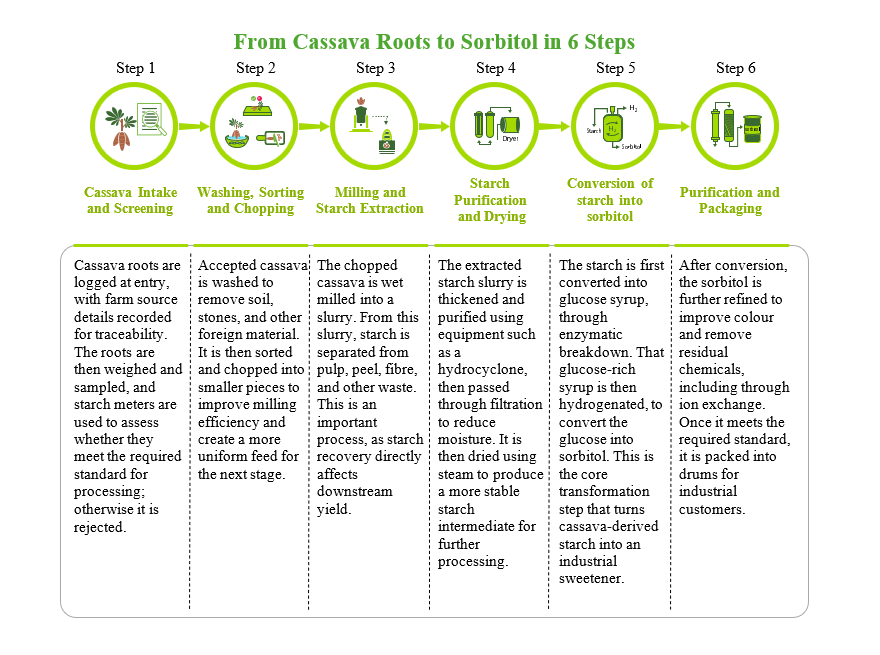
Cassava-based sorbitol production involves several stages, including an initial screening for starch content, starch extraction, purification, enzymatic conversion, hydrogenation, and final packaging.
Industrial Uses of Sorbitol
Sorbitol is used across a wide range of industrial products. In oral care, it is a common ingredient in toothpaste and mouthwash, while chewing gum, pharmaceuticals, processed foods, and confectionery products also contribute to demand. Its ability to retain moisture and provide controlled sweetness makes it valuable in several industrial applications.
What This Means for Cassava Industrialisation
Psaltry’s sorbitol plant demonstrates cassava’s potential as a high-value industrial input beyond traditional food uses. As local production scales, stronger domestic offtake could help reduce import dependence and support the growth of a more competitive market for cassava-based industrial products.