
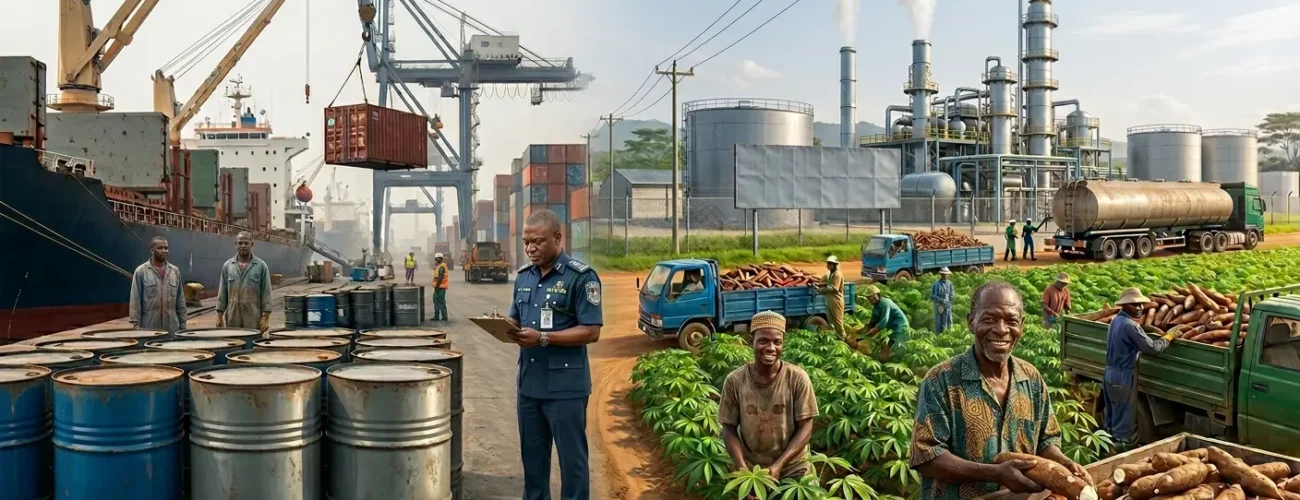
Nigeria’s ethanol demand reached 400 million litres in 2024, based on our analysis, and is expected to continue growing. Analysis from Clean Technology Hub indicates that about 75 percent of demand (roughly 300 to 350 million litres) is met through imports, while domestic production accounts for the remaining share.
According to the National Agricultural Extension and Research Liaison Services (NAERLS) Nigeria produces over 60 million tonnes of cassava annually, making it the world’s largest cassava producer, and giving it access to a raw material that can support large-scale ethanol production.
Our analysis, therefore, focuses on whether Nigeria’s agro-industrial sector can organise reliable cassava supply, and build processing systems capable of producing ethanol competitively at industrial scale.
Ethanol Demand Across Industries
Ethanol demand in Nigeria spans several industries. Beverage producers use it in spirits production. Pharmaceutical and hygiene-product manufacturers rely on it as a solvent and base ingredient in medicines. Cosmetics producers incorporate it across many formulations. As fuel-blending discussions gather momentum, additional demand could emerge from the energy sector.
Markets with diversified demand structures like this can support domestic production, provided supply systems are organised to meet industrial requirements.
Cassava as a Raw Material for Ethanol
Our research shows that under standard conversion conditions, one tonne of cassava can yield roughly 160 litres of ethanol. At that conversion rate, replacing current ethanol imports would require about 1.8–2.0 million tonnes of cassava, equivalent to roughly 3 percent of national production.
However, cassava to ethanol is a complex process with high capital requirements. Unlike commonly used sugarcane molasses, which can be fermented directly, starch must first be extracted from crushed cassava roots and enzymatically converted into fermentable sugars. The product of fermentation is ethanol and carbon dioxide.
Countries with large sugar industries use molasses. Cassava’s advantage lies in its availability. Nigeria produces cassava across multiple agroecological zones. Harvests can be staggered through coordinated planting throughout the year.
When supply systems are properly organised, cassava offers a domestically available feedstock that reduces exposure to foreign exchange volatility and import logistics.
Concerns about food security are often raised because cassava is also a staple crop. However, the volumes required to replace ethanol imports represent only a small fraction of national output. The larger challenge is ensuring that industrial demand develops within structured supply systems rather than disrupting local food markets.
A Market Signal from Industry
The most visible signal that cassava-to-ethanol production can be commercially viable comes from operators already active in Nigeria’s ethanol market.
Nosak Group, a major ethanol producer and operator of one of Nigeria’s largest distillery platforms, is building an integrated cassava supply chain through its subsidiary, Premier Plantations.
The company has reportedly acquired farmland in Edo State, developed outgrower partnerships, and is commissioning an additional cassava-to-ethanol facility.
In our assessment, this move reflects a strategic judgement: securing domestic cassava supply can reduce long-term exposure to the volatility associated with imports.
What Operators Must Solve
For operators considering cassava as a feedstock, three operational questions must be addressed simultaneously.
- Feedstock systems
Industrial ethanol plants require large volumes of cassava delivered consistently and within specification. Spot-market sourcing rarely provides the reliability required. Structured farmer networks, aggregation systems, logistics coordination, and quality incentives are essential. - Plant utilisation and economics
The economics of ethanol production depend heavily on plant utilisation, energy costs, and conversion efficiency. Facilities that operate below capacity struggle to recover their fixed costs. In addition to the core ethanol output, by-products such as fermentation residues, which can be used as animal feed, and captured carbon dioxide, for beverage production, can provide additional revenue streams and strengthen overall project economics. - Market alignment
Ethanol buyers have strict quality requirements. Beverage manufacturers need food-grade ethanol with traceability. Pharmaceutical and cosmetics buyers require compliance and batch-level consistency. Fuel blending, where it develops at scale, requires certification and reliable volumes. Operators must decide early which customer segments they are targeting, and engineer quality systems to match from the onset.
From Agricultural Supply to Industrial Systems
Cassava-to-ethanol production is already established in countries such as Thailand and Vietnam, demonstrating that the technology itself is proven.
Nigeria’s challenge lies in building the operational systems that make large-scale cassava processing reliable. Industrial cassava processing depends on consistent feedstock supply, coordinated aggregation and logistics, credible offtake markets, and financing structures aligned with the realities of industrial production.
Nigeria’s reliance on imported ethanol is therefore not inevitable. With the right systems in place, a small fraction of national cassava output could support significant domestic production.
The task ahead is to convert agricultural abundance into reliable industrial supply, expanding Nigeria’s agro-industrial base and boosting rural incomes.