
Cassava is one of Nigeria’s most important crops, with the potential to drive industrialisation and diversify exports at an unprecedented scale. Yet despite the country’s position as the world’s largest producer of cassava, its industrial use remains unpredictable and difficult to sustain.
The constraint is not demand, it is time.
Cassava’s Post-Harvest Constraint
Once harvested, fresh cassava roots begin to deteriorate, and very fast. Starch content falls, bruising spreads, and the roots become unusable for processing – all within 48 hours of harvest. This short window creates volatility across the supply chain.
For farmers, it means weak bargaining power and rushed sales at lower prices. For processors, it means unreliable supply and unpredictable factory operations.
This has become a fundamental barrier to industrialisation.
How Chips Extend Shelf Life and Reduce Volatility
Pre-processing of cassava to chips is gaining attention in Nigeria because it addresses this constraint directly.
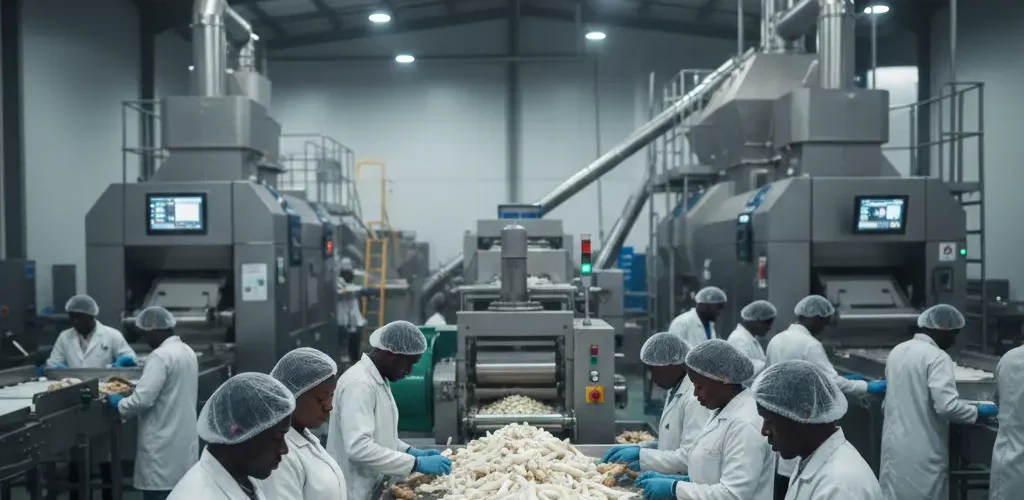
The process of making cassava chips is simple, but the impact on the value chain is significant. Fresh roots are sliced and dried to reduce the moisture content to about 12-14%. It is in this form that cassava is stored.
Drying converts cassava from a highly perishable “sell now” crop into a commodity that can be held, moved, and supplied with better planning and less urgency.
Instead of a two-day race against deterioration, properly dried and stored chips can last three to six months, sometimes up to twelve months.
This opens a new economic opportunity.
Pre-Processing Hubs Close to Farms
When pre-processing hubs are located close to farming communities, the riskiest part of the supply chain is shortened.
Fresh cassava is roughly sixty percent water. Removing that weight early, makes transportation cheaper, logistics simpler, and limits spoilage during movement.
Cassava chips can then be aggregated from multiple communities, transported over longer distances, and delivered to factories in more efficient truck loads.
In effect, preprocessing hubs function as stabilising infrastructure between farms and factories.
Why Quality Standards Matter for Cassava Chips
However, cassava chips can only work as a reliable industrial input when quality is consistent.
Moisture content and product hygiene are essential details in chips specifications. They determine whether cassava chips function as dependable industrial feedstock.
Reliable drying systems and proper storage conditions are some of the investments needed for ensuring quality discipline.
Therefore, suppliers must have an incentive for meeting buyer-defined specifications.
Clear specifications linked to pricing, can improve quality discipline across the value chain.
When these basics are in place, cassava chips start functioning as stored inventory that processors can plan around.
Case example: How Sofari Uses Cassava Chips to Stabilise Supply
Sofari Ltd. offers useful insight into how cassava chips can stabilise industrial supply chains.
The company produces high quality cassava flour and starch for industries, products that require consistent feedstock to maintain production schedules and quality standards.
Established in 2018, this female-led cassava processing company built its operations around decentralised pre-processing hubs rather than rely solely on fresh root deliveries.
By chipping and drying cassava close to farming communities, Sofari converts fresh cassava roots into stored inventory that can be aggregated, and its supply timed to match its factory intake needs.
Strict quality standards govern moisture levels, handling protocols, and storage from hub to warehouse and to factory gate. This operational discipline has allowed the processing facility to run more steadily, making planning possible and reducing exposure to supply shocks.
The model demonstrates that volatility is not inevitable, it can be managed with the right systems in place.
What it Will Take to Scale Cassava Pre-Processing in Nigeria
Expanding this model requires predictable demand of cassava chips and other cassava derivatives from off takers.
Patient, fit-for-purpose capital is also needed to grow pre-processing hub networks, build storage facilities, and improve quality control measures.
Companies must also work to deepen out-grower relationships with farming communities to secure reliable feedstock supply.
When demand pull from off takers is matched with appropriate financing, cassava pre-processing can evolve into durable infrastructure that supports industrial growth.
Why Cassava Pre-Processing Matters for Nigeria’s Industrialisaton
Cassava industrialisation will not scale on processing capacity and farm yields alone. It requires addressing the structural constraints that exist between farms and factories.
Pre-processing to chips is emerging as a practical way to do that. By extending cassava’s shelf life, reducing volatility, and enabling planning, it creates the conditions investors need to commit capital with confidence.
For Nigeria, the opportunity is not about producing more cassava, but about moving it efficiently, storing it safely, and supplying it consistently. Treating cassava pre-processing as infrastructure is a critical step in that direction.