
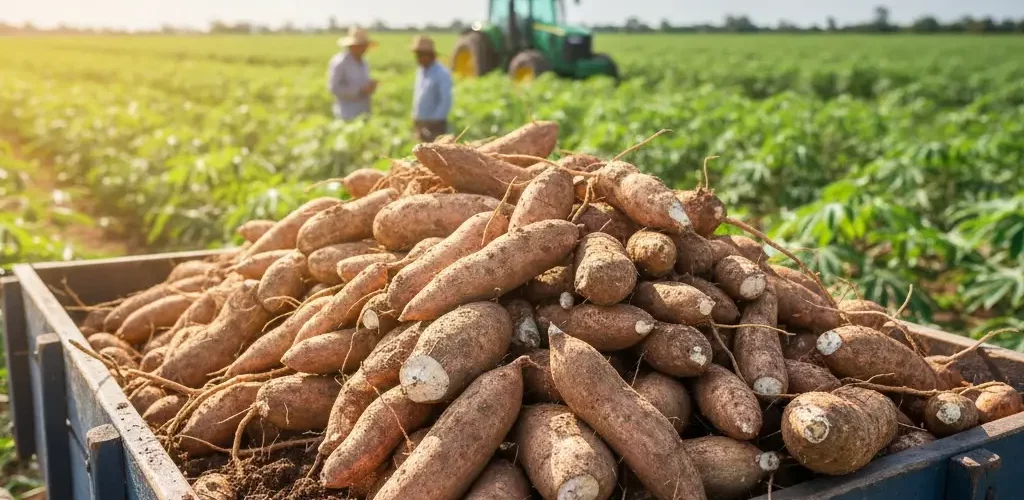
Nigeria is the world’s largest producer of cassava, yet the crop remains underleveraged as an industrial commodity. Processing capacity is expanding, new markets are emerging, and demand for cassava derivatives remains strong.
But one constraint appears across every segment of the value chain: finance rarely matches the realities of cassava production or processing.
This mismatch keeps farm yields low, weakens supply reliability, and makes it difficult for processors to scale—limiting cassava’s potential as an industrial commodity.
If cassava is to fulfil its industrial potential, financing structures must evolve to reflect its agronomic, commercial, and operational rhythms.
Nigeria’s Persistent Credit Gap
Agriculture contributes almost a quarter of Nigeria’s GDP and supports millions of households. But despite its scale, the sector receives less than five percent of total bank credit. For a crop like cassava, which requires upfront investment and long production cycles, this gap translates into chronic undercapitalisation.
In high-performing agricultural economies like Thailand and Brazil, agricultural lending typically accounts for 10–15 percent of total credit—enabling farmers and processors to invest confidently in productivity and value addition.
Nigeria’s much lower level of agricultural lending reveals a structural gap: the problem lies not in opportunity, but in the misalignment between finance and sector needs.
Why Cassava Industrialisation Requires a Different Financing Approach
Cassava takes nine to twelve months to mature. Most working-capital loans in Nigeria span only three to six months. This alone creates a significant barrier, but the challenges run deeper:
- Many farmers struggle to access input finance without collateral, formal records, or affordable long-tenor options.
- Aggregators lack financing for bulk sourcing and short-cycle storage, making cassava supply inconsistent and quality variable.
- Processors operate on thin margins, with feedstock and energy accounting for up to 90 percent of costs.
The result is a cycle where low yields limit supply, underfunded aggregators struggle to stabilise sourcing, and processors operate below capacity, despite strong market demand for cassava derivatives.
Where the Financing Gaps Appear
1. Production: Limited Access to Finance for Inputs and Mechanisation
Most cassava farmers operate outside formal finance systems. Even when credit is offered, short tenors and high interest rates make it unsuitable for a crop with a long maturity cycle. Without appropriate financing, farmers cannot invest in improved cassava varieties, fertilisers, or mechanisation, perpetuating low yields and supply instability.
2. Aggregation: Financing Constraints that Undermine Supply Stability
Aggregators also face financing constraints, particularly for bulk sourcing, quality assurance, and short-cycle storage. Without the working capital to perform these functions, supply becomes inconsistent, spoilage increases, and processors receive variable quality and unreliable volumes.
3. Processing: Thin Margins and High Capital Requirements
Processing faces high input costs and extremely thin margins, especially in segments where prices are constrained by imported alternatives. Without affordable working capital or long-term investment, processors struggle to maintain utilisation or expand capacity. Lending barriers push many into short-term financing that cannot support capacity expansion or competitiveness.
Building a Fit-for-Purpose Financing Architecture
Unlocking cassava’s industrial potential requires financial instruments that are tailored, not generic. Four categories of solutions are especially critical:
- Better-Structured Finance for Farmers
Input loans should be designed around cassava’s production cycle, including:
- 12–18-month facilities
- aggregator-led credit administration
- alternative credit scoring or group-based lending
These models reduce risk for lenders and improve reach to smallholder farmers, particularly those without collateral or formal credit histories.
- Working Capital and Asset Finance That Reflect Value-Chain Realities
Facilities aligned with cassava’s agronomic cycle and processing timelines can improve utilisation and lower costs. These may include:
- harvest-aligned repayment instalments
- balloon repayment structures
- lending backed by offtake agreements
- concessional or blended instruments from DFIs
- Patient Capital for Expansion and Greenfield Investments
Equity and quasi-equity instruments are essential for new plants and larger processors that need time to build sourcing networks, strengthen governance, and grow sustainably.
- De-Risking Mechanism to Attract Commercial Participation
Credit guarantees that absorb partial default risk and currency hedging tools that protect borrowers from exchange rate volatility can significantly reduce lender exposure. Grant-funded technical assistance can also strengthen borrower readiness and lower the cost of early-stage support. Together, these mechanisms make cassava-linked financing more commercially viable across the value chain.
Strengthening the Enabling Systems Around Finance
Financing alone cannot transform the cassava sector. Sustained impact will require continued research and development—both in farming and in processing. Extension systems must help farmers adopt improved practices and make effective use of new technologies.
Processors and aggregators need better investment readiness to meet lending requirements, while stronger market linkages—including predictable offtake arrangements—are equally essential. Supportive policy environments can also reduce transaction costs and improve operating conditions across the value chain.
Only when capital is matched by these enabling systems can cassava deliver on its full potential as a driver of inclusive industrial growth.
Looking Ahead
Cassava is one of Nigeria’s most versatile crops. It has the potential to drive food security, industrialisation, and rural economic growth. But realising this potential requires a financing system that reflects the realities of the crop and the businesses built around it.
Fit-for-purpose finance is the missing pillar—one that can strengthen every link in the value chain, unlock scale, and position cassava as a globally competitive industrial commodity.
NCIA continues to highlight these opportunities, engage partners, and advance solutions that bring the right type of capital to the right actors at the right time.