
Editor’s note:
This guest contribution shares the perspective of a private-sector operator in Nigeria’s cassava value chain. It reflects on the infrastructure, technology, and financing challenges that shape cassava processing, and offers insights into the investments needed to unlock the sector’s full industrial potential.
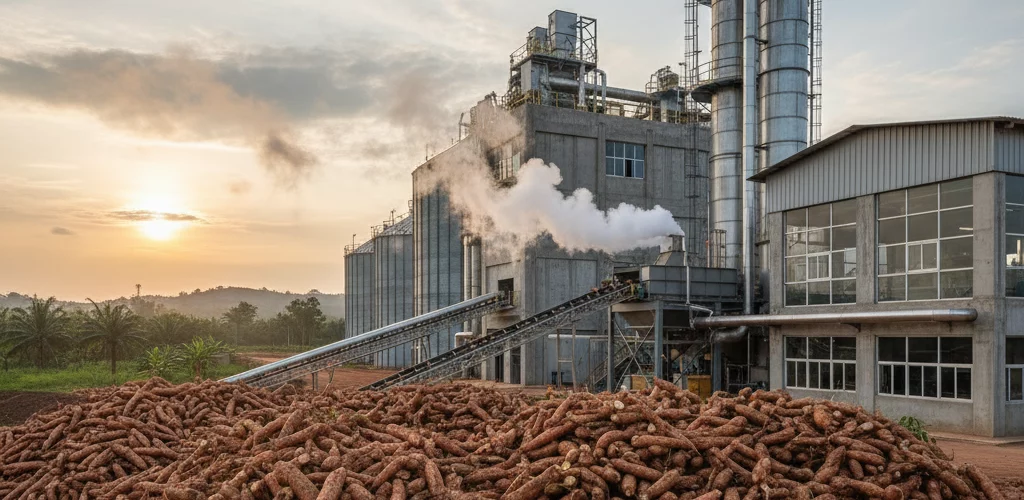
Nigeria is the world’s largest producer of cassava, yet only a small portion of this production is processed into higher-value industrial products such as starch, ethanol, and flour. The gap between production and processing remains wide, held back by weak infrastructure, high logistics costs, and productivity constraints that limit efficiency and scale.
Infrastructure Gaps
- Inadequate Power Supply: Most cassava processing plants rely on unreliable grid electricity or costly diesel generators, raising production expenses and hindering continuous operations.
- Poor Road Networks: Cassava-producing communities are predominantly located in rural areas with poorly maintained roads, making it expensive and time-consuming to transport bulky, perishable tubers to processing facilities.
- Insufficient Water and Waste Management Systems: Industrial-scale cassava starch and ethanol plants require substantial volumes of clean water and effective effluent treatment systems—both of which are often lacking in rural processing areas.
- Limited Storage and Drying Facilities: Cassava roots begin to deteriorate within 24 to 48 hours after harvest. The lack of adequate storage, drying, and preservation facilities discourages aggregation and large-scale processing.
Logistics and Coordination Challenges
- Fragmented Supply Chains: Cassava production in Nigeria is dominated by smallholder farmers, resulting in inconsistent raw material supply and fluctuating quality for processors.
- High Transportation Costs: The bulky nature of cassava roots, combined with long distances between farms and factories, significantly increases logistics costs.
- Weak Coordination Between Farmers and Processors: Limited farmer–processor linkages and the absence of structured contract farming create uncertainty in both raw material supply and pricing.
Key Investments for Growth
Addressing these challenges facing Nigeria’s cassava industry requires deliberate, well-sequenced investment across infrastructure, technology, capacity and financing. These enablers must work together to improve effeciency, lower production costs, and strengthen value-chain linkages.
- Rural Infrastructure Development: Improving feeder roads, expanding rural electrification (especially through renewable energy mini-grids) and ensuring reliable water supply systems near processing zones are essential.
- Processing Hubs and Industrial Clusters: Establishing processing hubs close to production zones with shared utilities such as power, water, and waste treatment will reduce operational costs and promote efficiency.
- Mechanisation and Post-Harvest Handling Technology: Investments in harvesting machinery, improved storage, and modern drying technologies can extend cassava shelf life and reduce post-harvest losses.
- Capacity Building and Supply Chain Coordination: Encouraging cooperatives, contract farming, and digital traceability systems can strengthen coordination between farmers and processors, improving consistency in supply and quality.
- Access to Finance: Affordable, long-term financing for farmers and processors is critical for scaling operations, adopting modern technology, and expanding processing capacity.
Improving Yields and Farm Productivity
While Nigeria leads globally in cassava production, the average yield per hectare remains below its potential. Closing this gap is essential to ensure a steady supply of high-quality materials for processing.
- Improved Varieties: Promoting the adoption of high-yielding, disease-resistant cassava varieties developed by research institutions such as IITA and NRCRI can significantly increase productivity and starch yield.
- Access to Quality Planting Materials: Developing certified seed systems and establishing multiplication centers will provide farmers with clean, high-quality stems for planting.
- Mechanisation: Introducing affordable mechanised solutions for land preparation, planting, and harvesting reduces labor bottlenecks and boosts efficiency.
- Extension Services and Training: Capacity building on best agronomic practices (including proper spacing, timely weeding, and pest control) can bridge the gap between potential and actual farm yields.
- Irrigation and Climate Resilience: Developing small-scale irrigation systems and adopting drought-tolerant varieties can help stabilise production amid erratic weather patterns.
- Access to Finance and Input Credit: Providing input financing and accessible credit facilities enables farmers to adopt yield-enhancing technologies and modern cultivation practices.
Conclusion:
Nigeria’s cassava processing potential remains largely untapped due to weak infrastructure, high logistics costs, and low farm yields. Targeted investment in rural infrastructure, mechanisation, and supply chain coordination – alongside efforts to boost productivity through improved varieties and modern agronomy – will be essential to achieving industrial-scale cassava processing.
Unlocking this potential will not only strengthen food security but also create jobs, attract private investment, and position cassava as a key driver of Nigeria’s agro-industrial growth.
Written by Adedamola Adeyemi
Director, Harvest Feed and Agro Processing Limited.
The views expressed in this article are solely those of the author and are shared with respect for diverse perspectives. They do not necessarily reflect the views or official position of NCIA.