
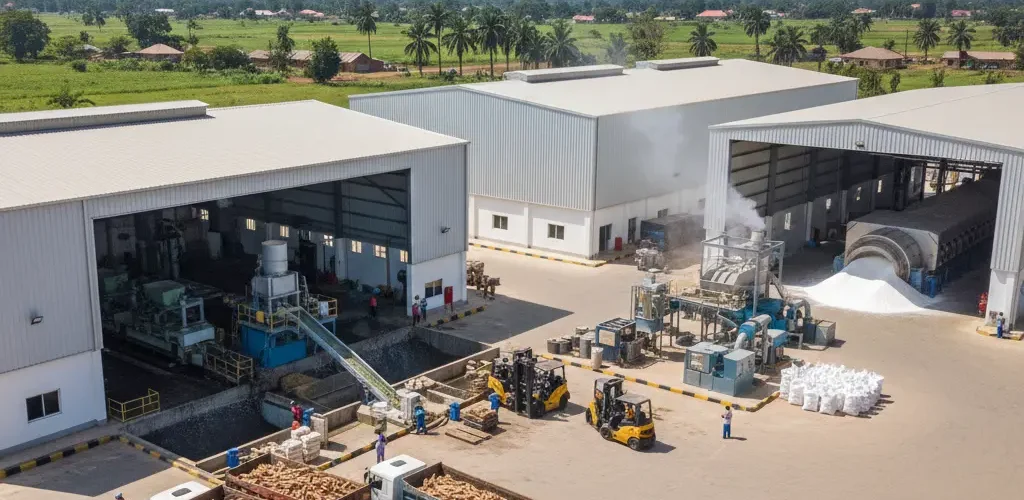
Investment in Nigeria’s cassava sector has been growing. Processing plants have been commissioned, capacity has expanded, and the policy environment has broadly supported industrialisation. On paper, the sector appears to be gaining momentum.
Yet, a different picture emerges at plant level. Insights from industry engagement show that many cassava processing facilities operate at 30–40 percent of installed capacity, not because demand is lacking or the technology is wrong, but because cassava does not arrive reliably.
As investment in processing continues, the challenge of feedstock reliability remains unresolved. Without it, returns on processing investment will continue to underperform.
What Breaks When Feedstock Is Unreliable
Unreliable cassava supply has immediate financial and operational consequences for processors.
A plant operating at 40 percent capacity still carries the fixed costs of a full-capacity operation, while generating significantly less revenue. This weakens the plant’s financial performance and makes it harder to meet debt obligations. Over time, operators could become trapped in a cycle where weak supply limits performance, and limited performance reduces their ability to invest in improving supply.
The impact extends downstream. Inconsistent operations make it difficult to meet buyer commitments, leading to lost contracts and reduced commercial credibility. At the market level, supply volatility creates sharp price swings, hurting farmers when supply surges and exposing processors to higher input costs when it tightens.
For investors, feedstock reliability is often a key execution risk. Even a well-structured processing asset with credible offtake can be difficult to finance if supply is not demonstrably reliable.
Farmer Networks Are Central to Supply
Many operators entering the cassava value chain aim to reduce dependence on external farmers by developing owned plantations. In practice, however, industry engagement shows that even integrated processors source a significant share of their cassava, often 60 to 70 percent, from surrounding smallholders and cluster farmers.
A mid-sized processing operation might require thousands of farmers in its network, delivering consistently to sustain throughput.
Farmer networks take different forms, including aggregator-led models, out-grower schemes, and cluster-based coordination. The structure matters less than how the network is managed.
Managing these networks is operationally demanding. Logistics are complex, coordination is continuous, and performance depends on systems that require deliberate investment. This is where many supply models begin to break down.
Without deliberate systems to manage them, farmer networks are unlikely to deliver the consistency that processing requires.
What Good Looks Like: Lessons from IDH’s Block Farming Model
Since 2014, IDH, the Sustainable Trade Initiative, has worked extensively in Nigeria’s cassava sector, generating useful insights into what makes farmer networks function effectively.
Its block farming model organises smallholders into structured production clusters anchored by a focal farm. These clusters are supported with defined delivery schedules aligned to processor requirements, alongside access to farm inputs and finance.
Reported outcomes from this approach include higher yields and improved farmer incomes, alongside more stable supply patterns through phased cropping.
While no single model is universally applicable, the key lesson is that structured, well-managed farmer networks lead to more reliable supply.
These principles can be adapted across different operating contexts. In practice, they point to a set of core operational priorities:
- Clear buying rules: Farmers need clarity on quality standards before delivery. Simple grading criteria applied consistently build predictability and trust.
- Fast, reliable payment: Payment timing influences behaviour. Prompt payment strengthens loyalty and prioritisation.
- Reliable logistics: Fixed aggregation points and scheduled pickups improve consistency.
- Performance incentives: Incentives encourage farmers to deliver consistently and meet quality standards.
- Conditional support: Linking farm inputs and extension services to delivery performance strengthens accountability.
- Basic tracking systems: Simple records of deliveries, quality, and timing provide the data needed to manage networks effectively.
The Foundation for Reliable Cassava Processing
While underperformance in cassava processing can, in some cases, be linked to demand conditions, policy constraints, or infrastructure gaps, industry experience shows that a more immediate issue is inadequate feedstock supply.
Cassava processing is a fixed-cost business. The difference between operating at 40 percent and 80 percent capacity can determine whether a plant is viable. Improving supply reliability is therefore one of the most direct ways to close this gap.
For producers of industrial cassava products, including starch, high-quality cassava flour, sweeteners, and bioethanol, structured farmer network systems play a critical role in improving feedstock reliability.
Feedstock reliability should therefore be a central consideration in evaluating opportunities in the sector. Projects that demonstrate a credible, structured approach to farmer network development are better positioned to translate processing capacity into consistent performance.
For investors, such projects present a fundamentally different risk profile.